
Careers That Count: Data, Risk, and Business in Insurance
What does a career in insurance look like if you're interested in data, risk, or business?
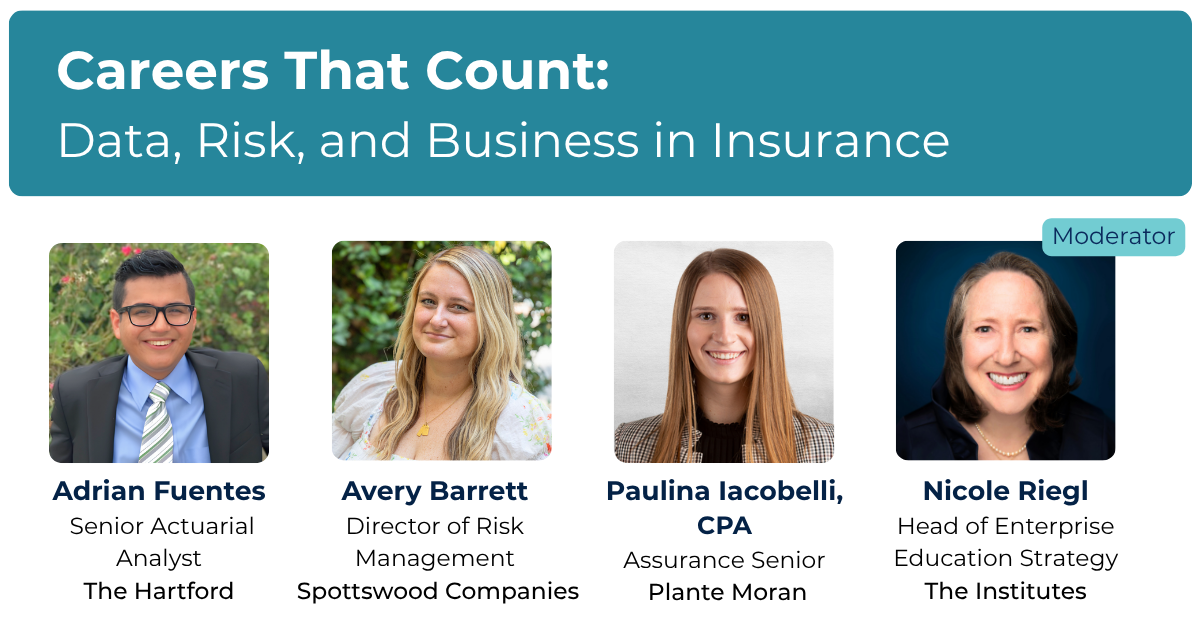
There are many ways to build a career in risk management and insurance, and they don't all start with the same major, degree, or first job. During MyPath's Careers That Count: Data, Risk, and Business in Insurance webinar, three early-career professionals shared what it's really like to work in actuarial, risk management, and accounting roles, the paths that led them there, and their advice for students getting started.
Three Different Paths Into Insurance
One of the clearest lessons from the panel was that there's no single route into a career in insurance.
Avery Barrett, Director of Legal and Risk Management at Spottswood Companies, discovered risk management while working for a restaurant company during college. She found that the field matched her interest in legal issues, problem-solving, and understanding how different parts of a business work together.
Adrian Fuentes, Senior Actuarial Analyst at The Hartford, started college studying engineering before realizing he was more interested in applied mathematics. After a professor introduced him to actuarial science, he changed his major and pursued internships that helped him confirm it was the right career for him.
Paulina Iacobelli, CPA, Assurance Manager at Plante Moran, knew she wanted to pursue accounting but didn't initially plan to specialize in insurance. Exposure to an insurance client early in her public accounting career introduced her to work she found interesting, and she continued building her expertise from there.
Their experiences are a reminder that you don't need to have your entire career mapped out before you graduate.
What Do Risk Managers, Actuaries, and Insurance Accountants Do?
Although all three careers connect to risk and insurance, the work can look very different.
Risk managers help organizations identify, understand, and manage potential risks. Their responsibilities can include insurance coverage, claims and litigation, safety, compliance, and analyzing data to help prevent future losses.
Actuaries use math, data, and statistics to help organizations understand and manage financial risk. Adrian described the work as helping answer three fundamental questions: What could happen in the future? How much could it cost? And what should we do about it?
Insurance accountants and auditors help organizations navigate financial reporting, accounting, and regulatory requirements. Paulina explained that auditing is also highly collaborative, involving regular interaction with clients and business leaders while using data to understand the story behind the numbers.
Despite their differences, all three panelists described careers that combine technical knowledge with communication, curiosity, problem-solving, and collaboration.
How Is AI Changing These Careers?
AI is already changing how work gets done across all three fields, but the panelists didn't describe it as replacing jobs.
Paulina shared that AI is helping entry-level accounting professionals process information faster and begin working with more complex analysis earlier in their careers. Adrian discussed using AI to support technical actuarial work, including coding, so he can spend more time analyzing results and contributing to business decisions.
From a risk management perspective, Avery highlighted another side of the conversation. AI can help organizations analyze data and make more informed decisions, but professionals also need to consider privacy, security, and how the technology is being used.
For students, the message was clear: learning how to use AI is increasingly valuable, but so are the human skills needed to question information, communicate findings, exercise judgment, and make decisions.
How Can You Start Preparing for These Careers?
Students interested in actuarial work can explore internships and learn about the professional actuarial exam process. Those interested in accounting may want to research CPA requirements and public accounting opportunities. And students considering risk management can gain relevant experience through areas such as safety, compliance, claims, loss prevention, or insurance brokerage.
But some of the panelists' advice applies no matter which path you're considering: ask questions, stay curious, build relationships, and be open to opportunities you may not have planned for.
As Paulina reflected near the end of the conversation, she wished she'd worried less in college about having the perfect plan. Adrian encouraged students to keep asking questions, while Avery emphasized reading and learning as much as possible.
Your first job doesn't have to be your forever job. Look for opportunities to learn, build skills, meet people, and discover the kind of work that plays to your strengths.
Explore Careers in Risk Management and Insurance
Want to hear more from Avery, Adrian, and Paulina? Watch Careers That Count: Data, Risk, and Business in Insurance on demand for the full conversation.
Then, visit the MyPath Careers page to explore more career paths and discover roles that match your interests and strengths.